


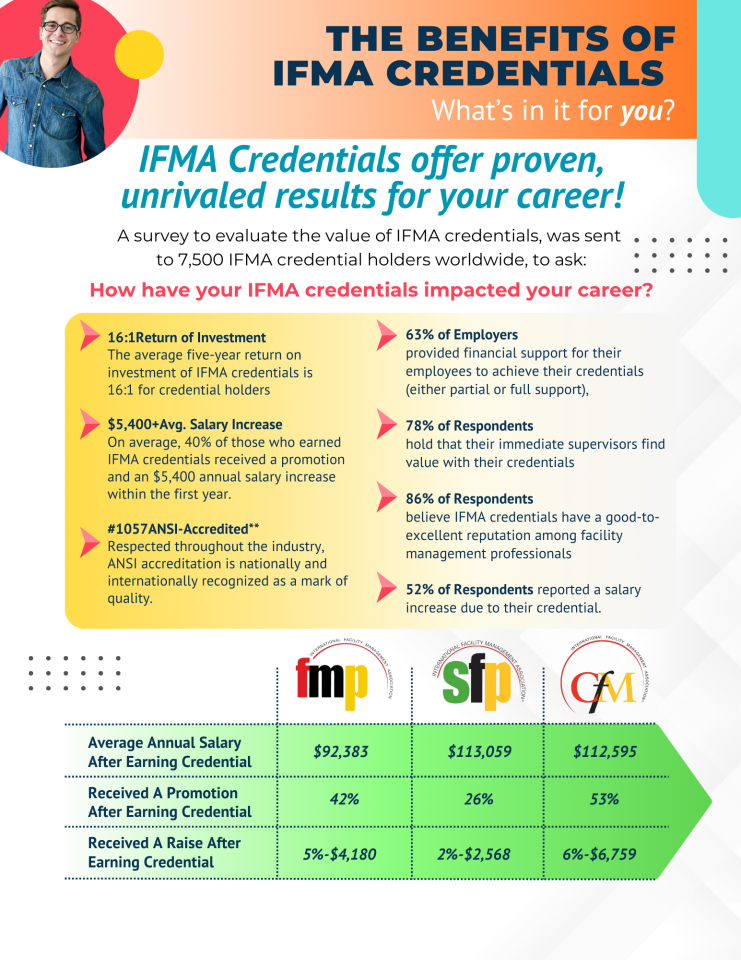
Enhance your career and expand your expertise with IFMA's industry-leading certificates and credentials! As a proud local chapter, ifmaKC is here to support your professional journey by connecting you with these globally recognized educational opportunities.
IFMA has structured their Certificates & Credentialing program so there is a credential alternative available for you as a facility management professional, no matter how long you have been involved in the field. Having a professional designation is a personal achievement and will set you apart from your peers. It could even provide you with greater opportunity for growth and advancement.
Get started locally with ifmaKC! We encourage all members to pursue ongoing education and professional growth. Whether you're working toward your first certificate or aiming for your CFM designation, we’re here to help you succeed — with prep courses, scholarships, educational monthly programs and more!
Essentials of Facility Management (EFM)
The Essentials of Facility Management (EFM) Certificate Program is perfect for those new to facility management or professionals seeking a deeper understanding of the field. This entry-level certificate program covers the basics of FM operations, maintenance, and management. It features short modules that can be completed at your own pace, making it ideal for individuals seeking foundational knowledge and practical skills.
Learn more about the Essentials of Facility Management Certificate here: Essentials of Facility Management
Facility Management Professional (FMP)
The Facility Management Professional (FMP) program is knowledge-based, self-study online coursework covering Operations, Finance, Project Management, and Leadership. The program includes interactive tools, final assessments, and requires passing four tests and submitting an application with a fee to IFMA for certification.
Learn more HERE!
Sustainability Facility Professional (SFP)
The SFP credential is knowledge-based, covering sustainability in facility management, intended to help you impact your organization’s economic, environmental and social bottom lines. It includes three main areas: Strategy and Alignment, Managing Facilities, and Operating Facilities. The program offers materials, online tools, assessments, and can be done through self-study or instructor-led. To earn the credential, complete coursework, pass three final tests, and submit an application with a fee to IFMA.
Learn more HERE!

Certified Facility Manager (CFM)
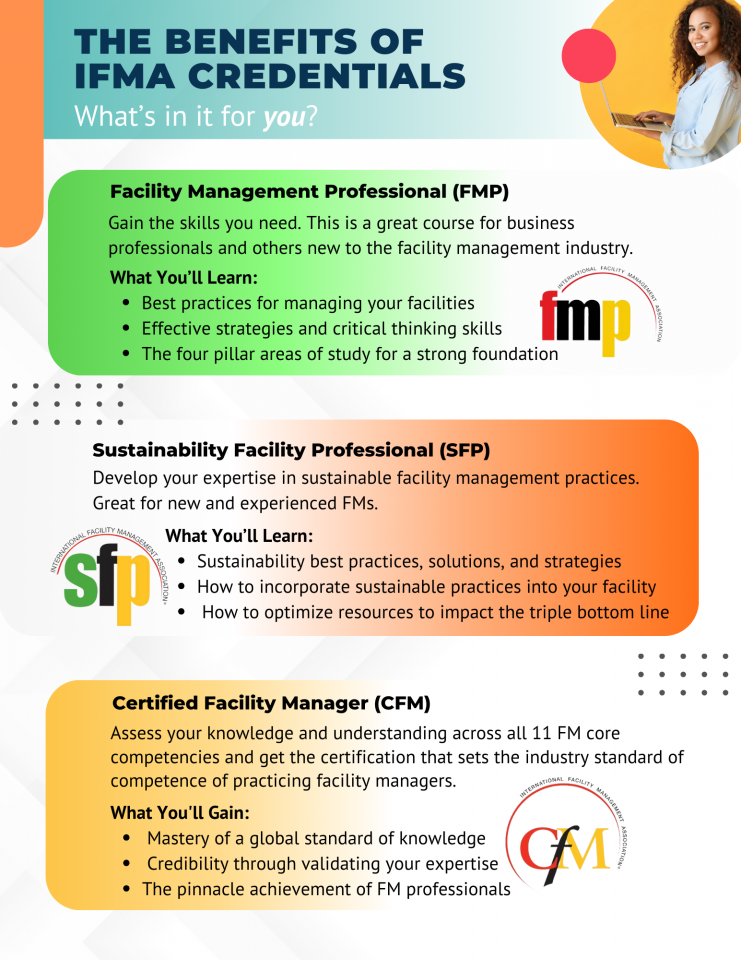
The CFM credential is highly respected in facility management, based on 11 core competencies. Prerequisites include education and experience, with ongoing maintenance requirements. Preparation resources like the FM Learning System and CFM Exam Prep Workshop are available. To earn the credential, applicants must submit an application and pass a comprehensive exam at a nearby testing center.
Learn more HERE!
New CFM Shares Experience
This week, I passed the CFM certification (unless Houston checks it and finds otherwise!)
Now I have worked in the area of Facilities and Real Estate for 16 years but came from the design side of it rather than building operations. I wasn't sure I had enough in-depth experience to pass all parts of the exam. I made high-level decisions about budget, direction, and real estate strategy, but I could not stand before you and explain exactly how a chiller works and how to fix it if it's not.
So, with the advice of Teena Shouse, I took the preliminary test on the website. While my results were less than fantastic, it made me feel that with a little prep, I might be able to pass. Then I took Teena's "most excellent adventure" CFM study session. It helped me feel much more comfortable by identifying strategies, providing some specific information that I had not been exposed to, and giving us a chance to talk to each other about situations that might be presented on the test. It helped me realize I needed to focus on what the questions were really asking of me. I also had to forget some things from the world I came from. For instance, where a correct answer on the exam might be "send an e-mail to all employees to inform them of an upcoming event", that would have been unacceptable protocol at my previous employer.
As I was going through additional prep questions and the actual test, I found it helped me to think of what category/competency the question was about (are they talking about communication or life safety?) --it framed it for me and often helped me eliminate one or more of the answers because they weren't the best answer for what the question's category was. The study session's strategies were right on--focus on the big picture, eliminate the "most wrong" answers, think of what is best for the business not just what you're being asked to do, and think of what your boss would be looking for or how s/he would address it.
And just do it!
Anna Graether, CFM